

DeConstruct and ReInnovate
- __radz___
- Aug 29, 2020
- 5 min read

Updated: Oct 12, 2020
Why is there a need to re-innovate a wasted garment when we can buy new and nicer pieces anytime ? Well, the reason is simple. We love our nature and do anything to make it a beautiful place to live in, even if our measures our really small. Maybe we get bored of our clothes too soon, overgrow them, and finally dump them. But what if we could we could change them by just adding a few elements and a little creativity. Sound interesting, right ? While designing a garment, a lot of waste is generated in terms of little bits remaining between the pattern pieces. Roughly 15% of the total fabric used by the fashion industry is wasted, which this is just one of the many ways that fast fashion negatively impacts the environment. These wasteful practices can be counteracted by 'Zero-Waste' fashion. It is when garments are produced with zero or very little waste. So, here am trying to do the same.
Part-1
DECONSTRUCT


These are the 2 garments that I chose to deconstruct.
Shorts, being the simple construction and A white shirt- complex. Both pieces belong to my father and were faded away, so I thought of choosing these ones.
For deconstructing the following garments, I required certain tools and follow a process-
1. Cutter blade, seam ripper and Snipper.
2. Start by taking off buttons, then collar, hand-cuff, sleeve placket, pocket, side seam, armhole, yoke, shoulder and finally hem.
While doing so I could see how the stitches are done and this garment is made. While the shirt had 'french seam' stitch, the sorts had 'interlocking'. I struggled more to open an interlocking.

After deconstructing these two pieces of garment and ironing all of them, I tried to place them in different ways, in order to achieve a zero-waste pattern. Also, the idea was to put the pieces on-grain, i.e., along the selvage (length-wise).


OTHER COMPONENTS


Other than just the fabric pieces, these are some of the other components that came out while deconstructing the garments. The first picture shows some buttons, the tag label and a plastic piece that was stitched in the collar end of the shirt. It was there to strengthen it's edge. The other picture shows an elastic band, Velcro piece and a label tag from the shorts.
Marker of minimum wastage


Part-2
RE-INNOVATE


I took a printed fabric to make a new garment. Placed the panels of the shirt on it and traced the outline with a chalk. Then, I cut the panels alongside. I did not cut the collar and collar stand in exactly the same manner because I wanted to use it as some design element, which requires a longer piece. In this way I could save some of my waste.
Waste Calculation
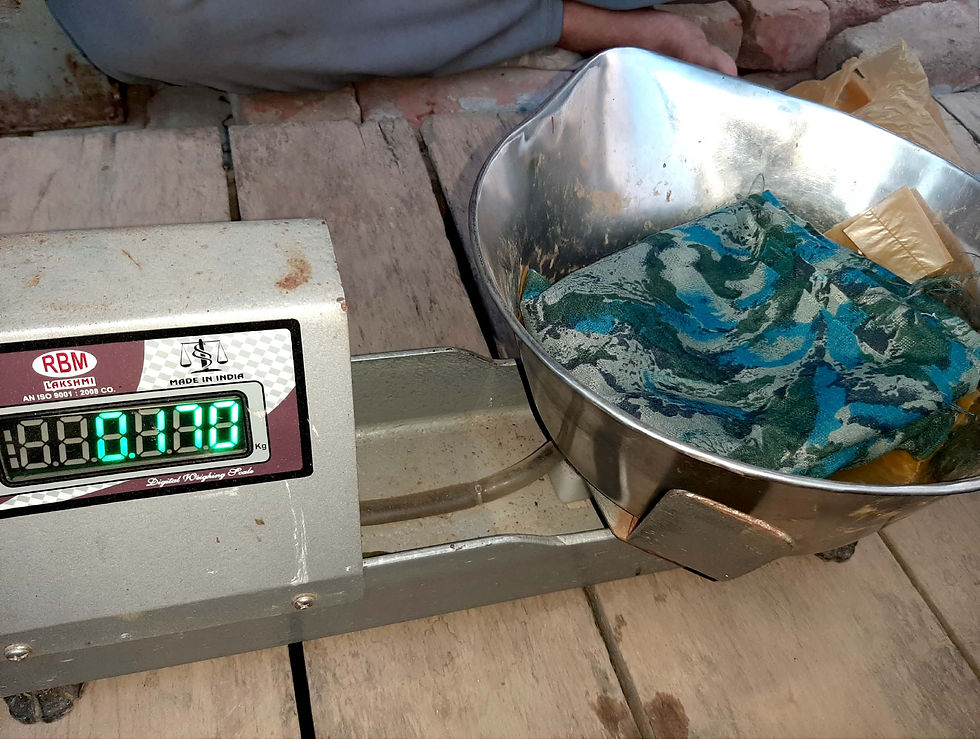
The area of the fabric used - 43' * 57.5'
Weight of the fabric- 170 grams
Weight of the leftover fabric(after cutting)- 35 grams
Waste %age= 35/170 *100 = 20.5 %
This is the calculation for when the shirt was originally made. This means 20.5% of the fabric got wasted.
Garment 1- Ideation

I had some manipulations in mind for what I wanted to make. I started by folding the sides of the front sides and giving it more straighter seam. Then, I decided to make the originally sleeve pattern into big Pockets. At the back, I attached the yoke and put a collar pattern in between by doing some gathers to give a Ruffle look. Also, I did the same on the upper seam of the front panels on both sides. Finally, I attached the front and back panels and the garment was ready.
FINAL LOOK


Unisex Jacket with Giant Pockets
Garment 2- Ideation

At the beginning, I was not sure what I'm about to make. I wanted to make it more fitted kind of garment. So, first of all I put 2 pleats each in the front panels and 4 pleats in the back. Then, I decided to manipulate the sleeves. The sleeves were shorter in the original shirt and had 2 big folds. I just decided to fold the sleeve pattern from the sides and not from the bottom, so that it becomes a little longer. Then, I noticed that the sleeves were coming out to be very loose, so I put a slit in it and attached 2 ribbon kind of things on each sleeve (originally collar stand pattern) and tied it, so that I could tighten the sleeves. Then, I joined/pinned the front panels, sleeves with the back panel. The garment required a collar as to give it a more formal look. So, i just folded the front panels, in a way it seems collars and attached another collar pattern on the back and joined it with the front collar. And voila ! The garment s ready.
FINAL LOOK


A FORMAL JACKET
Reflections
Creating a zero- waste garment was a bit challenging. Although there are various techniques to achieve it but in this case, we had to use the panels of an already constructed garment. I tried achieving minimum waste by following methods:
While cutting the panels, i had a design in mind of what I wanted to create, so I cut the fabric accordingly. It helped me save some fabric which rather would have gotten wasted.
Lesser curves at the seams are important. If it's more linear, lesser fabric will be required to make more panels and therefore creating more garments. lesser in-between fabric will be wasted.
Not the conventional but innovative ideas- For eg., when i used the collar and collar stands to give a more aesthetic look in the sleeves. Otherwise, it would have gotten wasted.
Design elements such as pleats, gathers, ruffles, tying, etc. can be used when we are working with a larger piece of fabric rather than cutting it into smaller pieces, which are never used further in your designs. Like, in my second garment, I had a larger piece of fabric but I wanted to give a fitted look. So, instead of cutting down the panel to reduce it's size and wasting the leftovers, I simply put pleats. It was functional and also gave my garment an aesthetic look.
Sustainable fashion is taking a pace in the fashion industry, trying to give it a better face which embraces nature. But still, I think consumerism is the main issue. Rather than buying new sustainable clothing, one should focus more on supporting and having a stronger connection with their own garments. Repair and maintenance is what is required. After doing this project, I'll focus more on customizing my garments and also sharing them rather than buying new garments everytime.


Comments