

Zero- waste Garment
- __radz___
- Sep 18, 2020
- 4 min read

Updated: Sep 18, 2020
In this project, I will create garments which follow a zero- waste pattern as we drape or fold them. It means, the garments will be made from a single piece of square or rectangular piece of fabric and will be folded in such a way that it creates a whole new wearable garment without creating any scrapes of waste fabrics. It is sustainable as no waste in the pattern making is generated.
I started by folding square paper sheets(10*10 cms) randomly and unintentionally. I folded around 20 sheets. Then, I Visualized the paper folds as garments having 4 openings- neckline, 2 armholes and bottom hem through cuts and slits and put it on a pen (as I didn't initially had a dummy). Below you can see the 10 selected paper folds, front and back.
PAPER FOLDS

After doing the paper folds, I did some digital sketches of the what the folds would look like on the croqui. I sketched out the details such as slits, buttons, ties, tucks, pleats, folds, etc.
DESIGN ITERATIONS


I did some more paper folds in order to explore more and finally chose 3 folds which I would go further with. Below is a video of the 3 selected folds and how they would look on a dummy.
3 SELECTED FOLDS
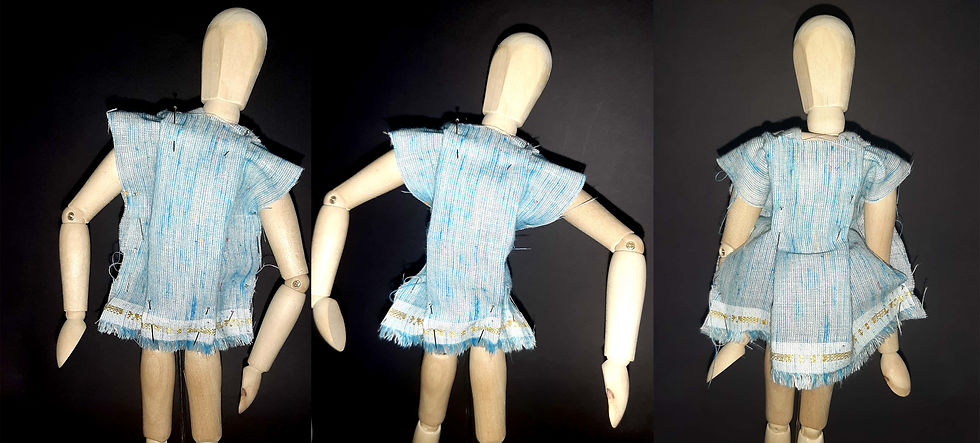
Now these folds are to be made into garments. So, firstly I tried miniature versions of the garments using piece of square fabrics on the wooden mannequin.
MINIATURE VERSIONS

SOME OTHER

When i tried the folds using fabrics on mannequin, it reacted very differently from it was on a pen- a paper fold. I added slits for armholes and pinned the fabric around the mannequin.
In the first design, there's a large triangular fold coming in front and it is mainly plain and simpl from the back. I additionallt added the belt on the waist to give it a shape and so that it rests easily on the body. In the second design, there's a armhole on the left and wrapped from under the shoulder on the right. I used cotton fabric so that it stands on the left shoulder but i don't know how it will react when it's made of an actual body size. I was confused which one to finalize for the third design, I did some other folds and wanted to make something that could be used or worn in multiple ways. I chose a simple fold, and tried putting it in different ways on the mannequin.
Other than these, I tried to create other folds from fabric to get an idea how they actually look on the mannequin and if they are achievable and practically possible.
After the miniatures, I started with the 3 Full-length garments.
GARMENT 1
(pinned)
Started by cutting a 43'*43' cotton fabric, and folding it according to the smaller version of it, which I did earlier on the mannequin.
FIRST ATTEMPT

It came to be a little different from how it looked on the mannequin. In the first attempt, I made it like a wrap- around, pinned together under the left- shoulder.
But I realized I need to add armholes and cover it more from the back. So I opened it and made another version which came to be surprisingly different from any of it.
SECOND ATTEMPT

I tried doing some pleats in the front and a rising bow on the left shoulder. I made an armhole on the left side and wrapped it from under the right arm. I liked but it was not challenging enough and didn't have much similarity from the fold. So, I made another garment from muslin following the paper fold pattern. Just this thime I was more cautious of the folds and coverings.
THIRD ATTEMPT

So, this was my third and final attempt. In this garment, I added and armhole on the right side and wrapped from under the left arm. I pinned this whole garment and it closes/ends on the left side seam.
GARMENT 2
(pinned)
Started by cutting a rectangular piece of muslin- 60' * 45'. While making the smaller version of this, I found out that a square piece had a smaller fall on the mannequin so I thought of increasing the length of the fabric.
FIRST ATTEMPT

Things to work on-
Add a belt in this garment and then see how it looks.
Fall below is coming out to be too deep. I will cut some of it and use it in creating pockets or cover more of the back.
The right armhole- the arm is not able to move.
SECOND ATTEMPT


The garment was complete in the second attempt. In this, I cut the fabric from below diagonally and used it to cover the back and make a belt. Machine-stitched the belt. The belt is not visible on the front as it goes from under the square fold on the waist area and is tied at the back. There are 2-3 folds happening in the front so I kept the back plain and simple. The garment is pinned and it end at the left side of the back. It has 2 armholes.
GARMENT 3
(hand- stitched)
For this garment, I cut the muslin of the size- 46'*20'. The idea behind this piece of garment is that it could be worn in 3 different ways just by buttoning it differently.
PROCESS

1. Fold it like a big Box Pleat in the center front.
2. Folded it half lengthwise.
3. Cut the neckline- traced same as one of my t-shirts and ironed the garment properly.
4. Hand- stitched the garment from wherever required in such a way that the stitches are not visible in the front but only on the inside of the garment (side-seam and center folds)
5. Added buttons(6). Instead of the plastic buttons, I chose to put the ones which are covered with the waste fabrics. Also, I put small slits for buttonholes.
6. The cut-outs from the neckline were used as pocket flaps (at the bottom of the center- front).
FINAL LOOK

First way is to wear it in a way that it looks straight from the sides and has pockets in the front. It gives a definite rectangular kind of look to the wearer.

Second way gives a curve on the waist and has like a x- cross look. In this, one will have to button the slit on the waistline.

Third way gives a different kind of sleeve-look to the wearer. In this, I put button from around my arm.


Comments